Network Stability
You cannot build a smart home on consumer-grade ISP routers. As you scale from ten connected devices to fifty, and eventually over a hundred, standard routers buckle under the concurrent connection requests. The result is devices dropping off the network, delayed responses, and an inherently frustrating user experience.
"Your network is the central nervous system of the automated home. Neglect it, and the entire structure collapses."
Isolating IoT Traffic
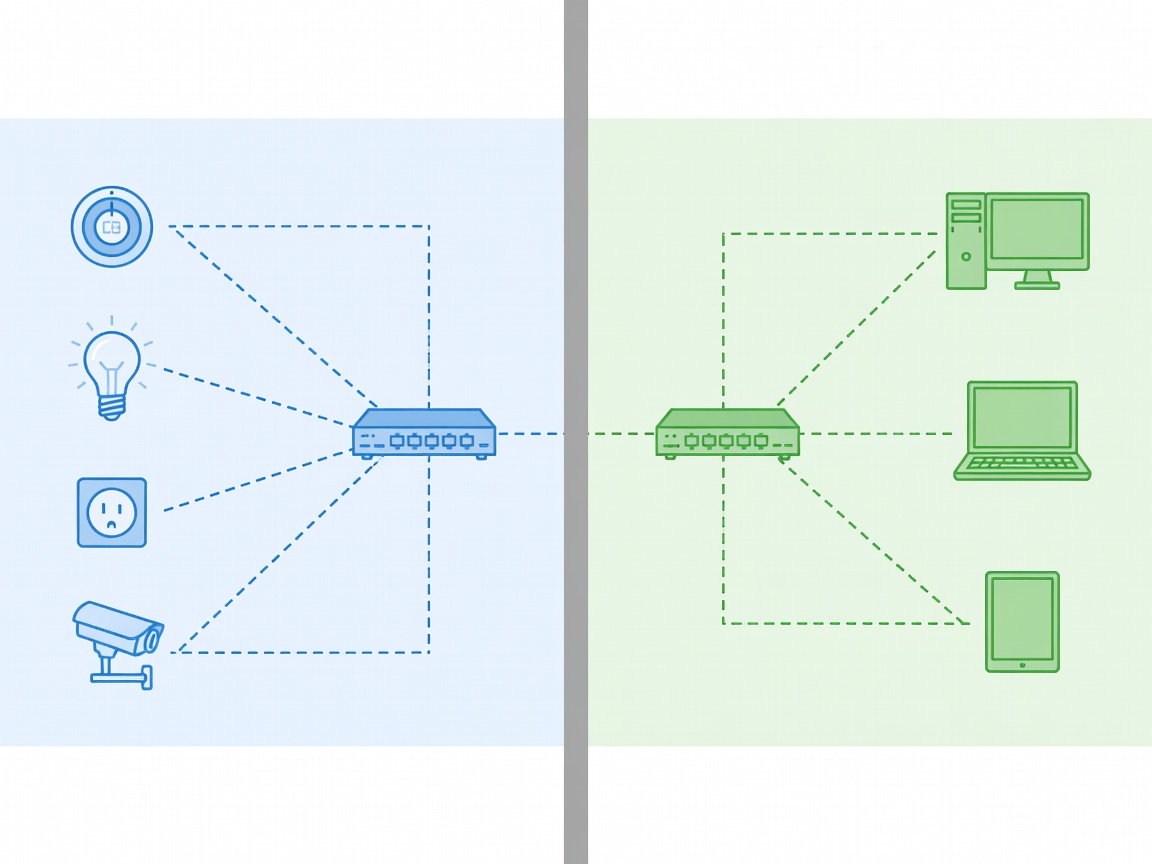
Smart home devices are notoriously insecure. A compromised internet-connected lightbulb can theoretically act as a vector for malicious actors to access your primary network, compromising laptops and personal data. Professional architecture dictates the use of Virtual Local Area Networks (VLANs).
By segregating IoT devices onto an isolated VLAN, you quarantine them. They can communicate with the local hub, and perhaps access the internet for updates, but they are strictly barred from communicating with your trusted personal devices. This zero-trust methodology is standard in enterprise environments and is now mandatory for the modern automated home.
Mesh Wi-Fi vs. Wired Access Points
Wireless mesh networks are convenient, but they rely on wireless backhaul—using part of their own bandwidth to communicate with one another. In high-density IoT environments, this leads to spectrum congestion.
The superior approach is hardwiring dedicated Wireless Access Points (WAPs) via CAT6 ethernet back to a centralized Power over Ethernet (PoE) switch. This guarantees maximum throughput, drastically lowers latency, and ensures that critical 2.4GHz and 5GHz spectrum is reserved entirely for end devices, not for routing overhead.